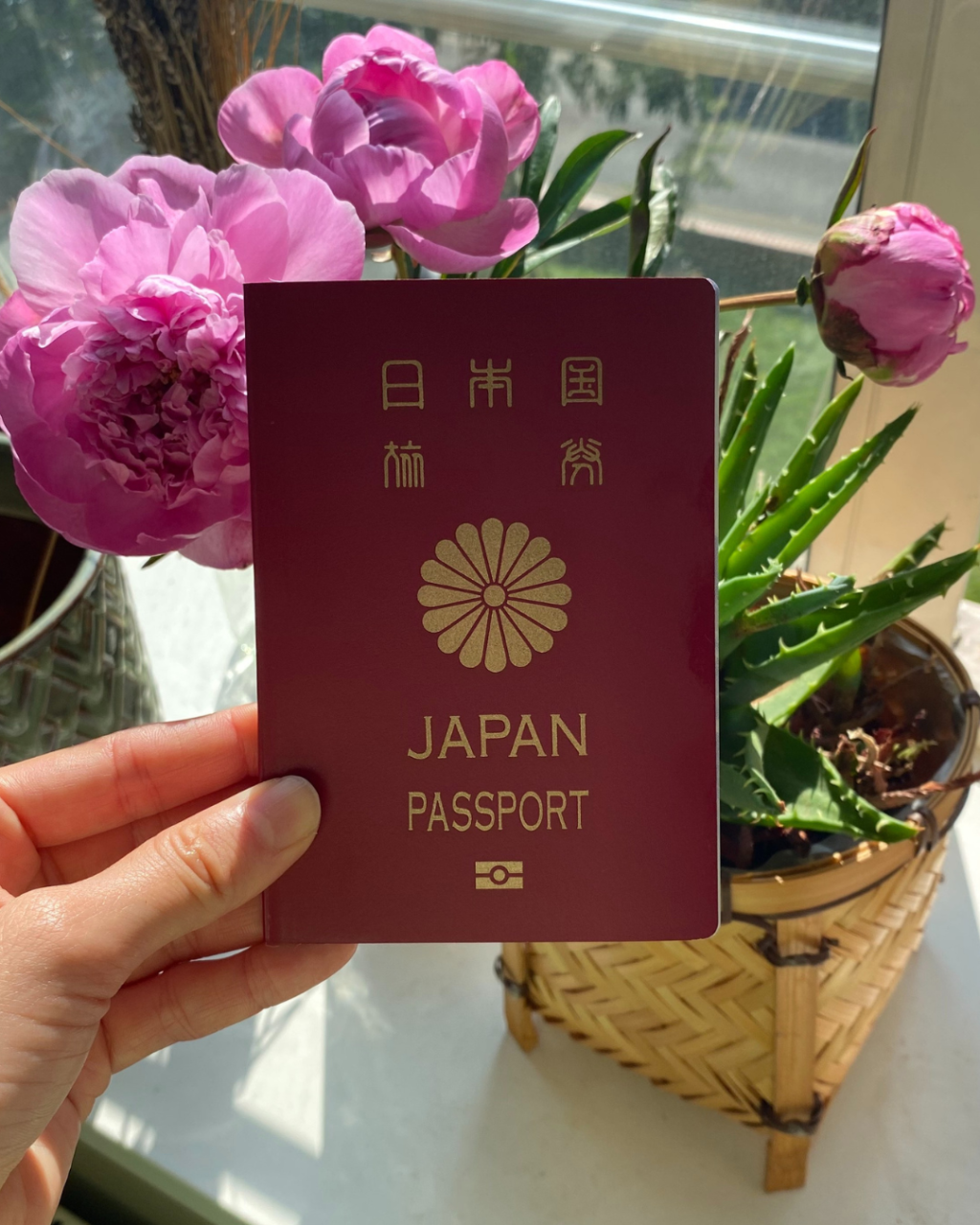
I have often feared that when my mother dies I won’t feel Japanese anymore. First, my grandma will pass and we’ll sell her cluttered home in Kakogawa. It will be brought by a new family, cleared of her down to a stray eyelash and never set foot in again. Then my mother will die, and with her last breath she’ll stuff her lungs with whatever Japaneseness I had left. After that, I won’t know who I am anymore. I’ve fretted about no more home cooking, no need for Japanese phrases, no more Japanese card games, no more kendama, no more jankenpon (rock paper scissors) and no more ‘crossing noodles’ on New Year’s Eve. I imagined my Japanese side thrown up in the air and never returning to ground. Then I found out that I was able to get my Japanese passport, and all my worries disappeared overnight.
Japan holds the purse strings of citizenship tightly. It is one of the few countries where citizenship is restricted to those who are tied by blood. No amount of tax-paying or toiling in the long-houred workforce will grant you the prestige. If you have Japanese parents but were born in the diaspora, it’s possible but remains challenging. You must be registered in Japan within three months of your birth. Up until a month ago, I was convinced the cause was hopeless. It was only when my sister went to lengthy investigations that things started to look up. She slipped five thousand yen in an envelope and mailed it overseas. My grandma then used that cash to get a cab to the town hall. There, with the crushing weight of our nationalities on her stooped shoulders, she found the document that proved our registration. So began our applications to the embassy to become Japanese.
Before now, my feeling of being Japanese was parasitic. In the same way that a no-good husband relies on their wife for the basic necessities of living, my Japanese identity needed an external host. For years, it lived on the back of my mother’s head. I am equal parts Japanese and English, but culturally I am far more British. When I was younger, I remember my mother giving me a ume (plum) sweet. It was deep maroon with a hard shell and fleshy inside. I looked down my nose at it. I cracked the outside with my teeth and unleashed the sickening tart flavour. My mouth filled with saliva and I grimaced. ‘I don’t like it,’ I apologised. My mother’s eyes widened and her little mouth dropped into a ‘o’. ‘You are not real Japanese, all Japanese like this one,’ she said. After that, I ate the vile things without fuss.
Now I can spit the sweets out because I have a government-certified document. Oh, the joys of bureaucracy! Being a part of any culture is special and I am careful not to inflate my passport’s significance. In reality, I wake up every day and do the same things I did before. I don’t now wake up and check the Japanese time, stretch my Japanese arms, wash my Japanese face and cry my Japanese eyes out. I have always been Japanese, whether I’ve felt it or not. It is in my blood, in my thick, straight hair. It is in my mannerisms and my compulsion to wear slippers in the house. What the document does give me, however, is the liberties and rights of a Japanese citizen. I didn’t know how much I wanted that freedom until I got it. If every Japanese relative I have tragically dies, I will still be able to live there indefinitely. I will still be able to claim it as something that I belong to.
When I signed the paperwork I had to practice my signature at least fifty times. It’s my name, and yet I cannot write the characters well. The signature I did produce was infantile. The shapes are crooked and the lines mis-spaced. On the very treasure that proves my Japaneseness, my penmanship mocks it. It reminds me that I may be a Japanese citizen but I am still English. The passport doesn’t culturally assimilate me and, when I next go to Japan, I will continue to be a foreigner. People will still speak to me in broken English rather than Japanese. They will still be able to point me out in a crowd from a mile off. They will still offer me tax-reduction prices available only to those with non-Japanese documents.
Once you have your passport, you’re on the email list for news from Japan. You get updates about weather warnings and anything of public note. A couple of days after picking it up, I recieved an email from the embassy that said: ‘Welcome to Japan.’ I imagined the gatekeepers opening the border and bowing as they let me through. Despite the document being mostly symbolic, it really does mean a lot to me. I’m sure all mixed-raced/mixed-cultured people can relate to that. My Japanese identity now has its own legs. It’s not something that can be snatched away from me. I am now not only half Japanese by my mother. I am Japanese all on my own, and have a little book to prove it.
If you liked this, check out some of my other recent pieces:
That’s all this time. Leave a comment with your thoughts! Goodbye for now (◕‿◕)♡

 @icantstoptalkingblog
Leave a comment